
Send a Message to Hampshire County Council to Stop 4x4s in the River Meon
Please help us by sending a message to Hampshire County Council to ask them to put a stop to 4x4s in the River Meon.
There are sample messages in the templates below but if you personalise your message it will give it more impact.
The email addresses to send your message to are at the top of the templates.
Or write to:
Cllrs Steve Forster and/or Kirsty North
Hampshire County Council
The Castle,
Upper High Street,
Winchester,
SO23 8UJ

What is happening?
A short stretch of the River Meon at Droxford is being used by 4X4 vehicles and motorbikes for recreational driving directly along the riverbed. Vehicles are repeatedly driving up and down the river, not simply crossing it. We’re asking Hampshire County Council to put in place a Traffic Regulation Order (TRO) to stop them.
Frequently Asked Questions
Is driving through the River Meon actually legal?
At present, the route is designated as a public highway, which is why vehicle use is currently allowed. However, the law also allows councils to restrict or prohibit use where clear environmental harm is occurring. Traffic Regulation Orders (TROs) are specifically designed for situations like this and have been used successfully elsewhere. Legality does not mean unrestricted use is always appropriate.
If it’s legal, why are you calling for restrictions?
Because it is legally classed as a highway doesn’t mean it is right to drive down the riverbed. There is strong evidence that vehicle use at this location is causing ongoing damage to a protected and globally rare habitat. Where continued use leads to environmental damage, public authorities have the responsibility to act to prevent further harm. The existence of legal powers to restrict access recognises that circumstances can change. TROs are designed for situations like this.
The Meon is also designated by Natural England as compensatory habitat to the SAC-protected River Itchen, meaning it should enjoy the same protection as that of the Itchen. In eƯect, government policy requires public bodies to prevent deterioration of the river environment.
What is a chalk stream and why are they so special?
Chalk streams are among the rarest freshwater habitats in the world. There are only around 260 globally, and the majority are found in England. They are fed by underground chalk aquifers, which provide exceptionally clear, clean water and a stable flow year-round.
These conditions support specialised plants and wildlife that cannot survive elsewhere. Chalk streams are also extremely sensitive. Once damaged, they recover very slowly, and in some cases, may never fully recover. Because of this rarity and fragility, chalk streams are recognised as habitats of national and international importance.
Why is the River Meon particularly important?
The River Meon is one of only 260 chalk stream in the world. It supports species such as brown trout, Atlantic salmon, water voles and otters. Fish like trout and salmon rely on clean, loose gravel to spawn, which is a defining feature of healthy chalk streams.
Isn’t this just a normal stream crossing?
No. This is not a short or incidental crossing. Vehicles are driving through approximately 200 metres of the riverbed itself. Repeated use along this length causes cumulative damage that does not occur at brief, shallow crossings.
What damage is actually being caused?
Vehicles driving through the river churn up gravel beds, remove plants, disturb wildlife, and alter the shape of the river. Over time, the river becomes wider and shallower, and the gravel needed for fish to spawn is lost. When spawning gravels are disturbed, and plants are removed, the whole river ecosystem is affected, from insects through to fish, birds and mammals.
Surveys commissioned by the authorities themselves show degraded habitat and reduced biodiversity on this stretch compared with upstream sections.
Isn’t this about stopping people from enjoying the countryside?
No. It is about protecting a rare chalk stream habitat and its wildlife. We support people enjoying the countryside responsibly. This campaign is not against recreation or access in general. It is about recognising that some places are too fragile to absorb certain activities without permanent damage.
There are lots of places where people can drive for fun, but only a few chalk streams are left in the world. Protecting the river ensures that everyone can continue to enjoy this river, and its wildlife, into the future.
Why not rely on voluntary agreements instead of restrictions?
Voluntary approaches have already been tried and have not prevented ongoing damage. We are asking for a targeted restriction at one highly vulnerable location. This is not a blanket campaign against green lanes, trail riding or 4×4 use elsewhere.
What will happen if nothing is done?
Continued vehicle use will cause further degradation of the riverbed, loss of wildlife habitat, and reduced ability for the river to recover. Once chalk stream habitats are damaged beyond a certain point, they may never fully recover.
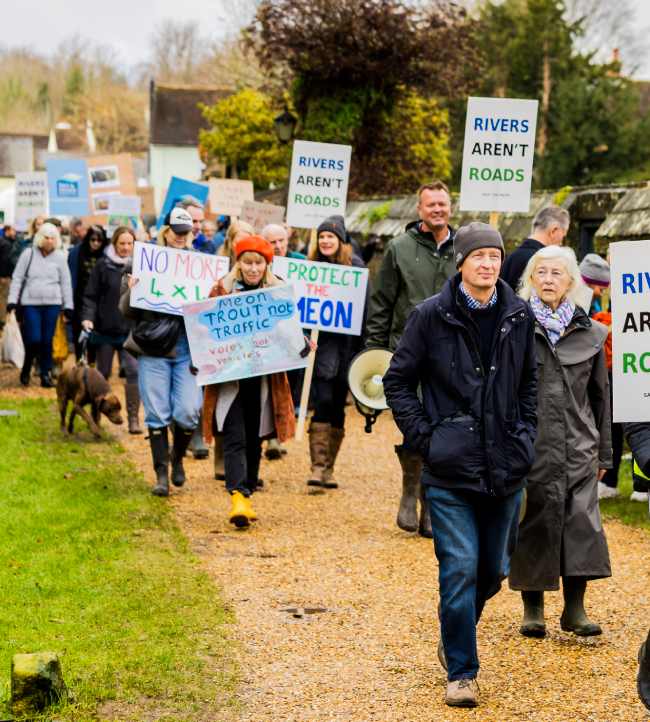
If you can help with the campaign, or would like to be kept up to date with progress, please register your interest with the local campaign organisers.

